
Skidpad Testing: Measuring Vehicle Cornering, Grip and Stability
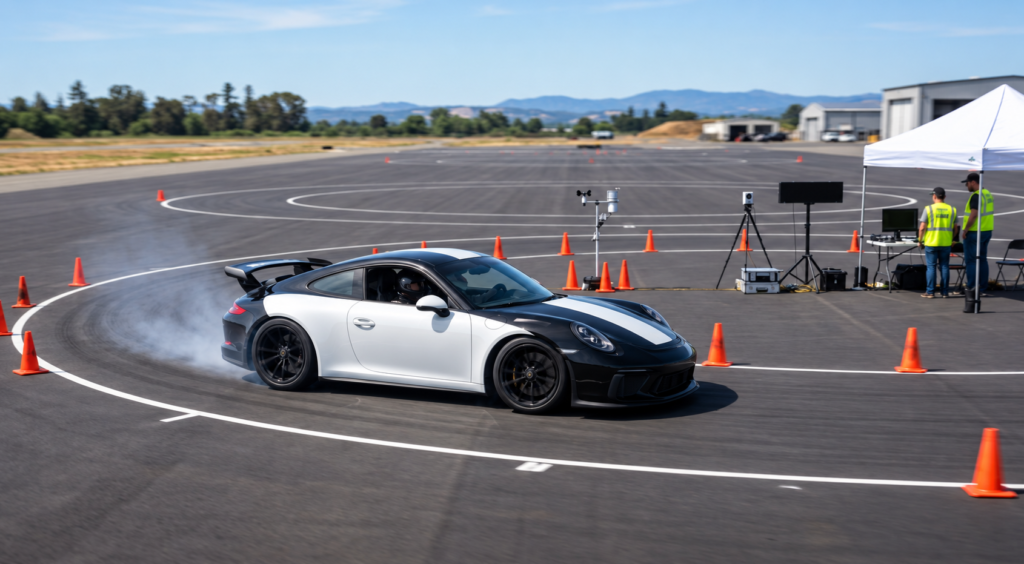
Engineers rely on the skidpad test in Pune to assess vehicle control during sustained sideways force. By driving in a constant circle, experts conduct a vehicle cornering test to measure the maximum lateral acceleration before the car loses traction. This process reveals a vehicle’s overall grip, balance, and mechanical stability, making it an important automotive handling test for evaluating vehicle dynamics.
For drivers in India, skidpad test results help them make informed vehicle safety decisions. However, controlled track results cannot fully match unpredictable public roads. Heavy monsoon conditions, erratic traffic, and poor road surfaces create challenges beyond simple laboratory measurements.
Key Takeaways
- The procedure measures lateral acceleration to determine how well a car handles corners.
- Performance data highlights the relationship between tire grip and chassis balance.
- Controlled environments provide a baseline for comparing vehicle stability across different models.
- Track results serve as a guide but do not account for real-world hazards like monsoon rain.
- Drivers should balance technical specifications with the realities of daily commuting in India.
What a Skidpad Test Measures
Understanding a skidpad test shows how engineers measure a car’s true cornering ability. This vehicle cornering test creates a controlled setting for finding the limits of the chassis and tires. Engineers use a fixed path so each run stays consistent and easy to compare.How a Constant-Radius Circle Reveals Cornering Performance
The test requires driving around a perfect circle with a known radius. The fixed radius lets the driver focus on steady speed near the tires’ grip limit. This design removes road variables and supports precise data collection.
The Relationship Between Lateral Acceleration and Grip
Engineers calculate lateral acceleration with the formula a = v²/r, where v represents velocity and r is the circle’s radius. As speed rises, the force on the tires grows quickly. This measure shows how much grip the tires provide before losing traction.Why Stability Matters Alongside Maximum Cornering Speed
A high-performance vehicle stability test must examine a car at its limit, not only its top speed. A fast but unpredictable car is hard for a driver to control safely. Engineers seek balance, even as the tires begin to slide.Understeer, oversteer and neutral handling behavior
Handling types show how a vehicle responds to steering during a turn. Understeer occurs when the front tires lose grip, so the car pushes wide of its intended path. Oversteer occurs when the rear tires lose grip, so the tail swings outward. A neutral setup follows the steering angle without excessive front or rear sliding.| Handling Type | Front Tire Behavior | Rear Tire Behavior | Driver Experience |
|---|---|---|---|
| Understeer | Loss of traction | Maintains grip | Car pushes wide |
| Oversteer | Maintains grip | Loss of traction | Tail swings out |
| Neutral | Balanced grip | Balanced grip | Predictable turn |
How Engineers Set Up a Vehicle Cornering Test
The vehicle cornering test requires careful preparation and a controlled environment. Engineers must remove variables that could distort data, so measurements show the automobile’s true mechanical limits.Choosing the Skidpad Surface and Circular Layout
The test needs a perfectly flat, circular track with a set radius. Engineers usually choose smooth asphalt or concrete because these high-friction surfaces provide steady grip. A uniform surface keeps bumps or debris from upsetting the vehicle’s balance. A constant radius lets the team study lateral acceleration as the main variable.Preparing Tyres, Pressures, Suspension and Vehicle Load
Before the vehicle handling test begins, engineers set the car to a specific baseline configuration. They check that tyre pressures match the manufacturer’s recommendations for high-performance driving. Engineers also measure the vehicle’s total mass, including fuel, passengers, and cargo. Even small changes in suspension geometry or ride height can greatly change weight distribution during a turn.Using Cones, Data Acquisition Systems and Safety Equipment
Engineers place markers around the circle to guide a precise line. These visual aids keep the driver on the intended path while specialized hardware records performance data.- Data loggers to capture real-time G-force and speed.
- High-visibility cones to define the circular boundary.
- Safety gear, including fire extinguishers and emergency medical support.
Controlling temperature, wind and surface conditions
Environmental factors strongly affect a vehicle cornering test. High temperatures can soften tyre compounds, while strong winds may push the vehicle from its ideal line. Engineers often check the surface for dust or moisture that could reduce traction. Stable conditions help them gather repeatable data across testing sessions.Repeating runs to improve test consistency
One pass rarely validates a vehicle handling test. Teams make multiple laps clockwise and counter-clockwise to account for track banking or driver bias. By averaging several runs, engineers can filter out unusual results. This careful process makes the final figures reliable, objective, and representative of the vehicle’s actual capabilities.How the Skidpad Test Is Conducted
A skidpad test uses controlled maneuvers to push a vehicle toward its handling limits. Engineers follow strict, repeatable steps to measure lateral grip and overall stability.Entering the Circle and Building Up Cornering Speed
The driver enters the circular track at a low, steady speed. After the vehicle settles on the correct radius, the driver slowly adds throttle to build lateral acceleration. Gradual inputs are essential for keeping the vehicle balanced during this transition.Maintaining a Consistent Driving Line and Throttle Input
Consistency creates reliable skidpad test results. The driver holds a precise line, keeping the tires on the painted circle or marked path. Erratic steering or sudden throttle changes can distort the final performance measurements.- Maintain a constant steering angle to keep the radius fixed.
- Apply throttle smoothly to avoid upsetting the chassis balance.
- Focus on visual markers to ensure the vehicle stays centered.
Recording Multiple Laps in Both Directions
To account for track banking or wind, the test runs clockwise and counter-clockwise. Averaging these results shows the vehicle’s true capabilities. This practice reduces the driver’s influence on the final data.Managing tyre slip without leaving the test path
As speed rises, the tires naturally begin to lose traction. The driver manages this slip angle with small steering and throttle adjustments. Staying within the test path is critical because drifting wide invalidates the maximum lateral force measurement.Identifying the point where grip begins to fall away
The skidpad test reaches its limit when the vehicle cannot maintain its line at higher speeds. At this point, more power causes understeer or oversteer instead of faster cornering. Recognizing this threshold reveals the vehicle’s usable performance range.How Skidpad Results Are Calculated and Interpreted
Engineers turn raw track data into useful insights through precise math. They study this information to find a vehicle’s true cornering limits during an automotive handling test.Calculating Lateral Acceleration from Radius and Speed
Lateral acceleration is the main measurement from these tests. Engineers use the standard physics formula a = v²/r, where ‘v’ means velocity and ‘r’ means the circle’s radius. They square the speed, then divide it by the radius to find acceleration in meters per second squared. They convert this figure into a multiple of gravitational acceleration, commonly called ‘g’.Understanding the Meaning of G-Force Measurements
A result of 1.0 g means the vehicle creates lateral force equal to Earth’s standard gravitational pull. This benchmark shows how hard a car can push against the road before losing traction. This figure shows peak ability under controlled conditions. It does not mean the vehicle can sustain such forces on uneven or unpredictable roads.Comparing Grip, Balance and Repeatability Between Vehicles
When experts evaluate an automotive handling test, they look beyond the peak g-force number. They study the vehicle’s behavior throughout the maneuver to check that the data is reliable. A complete analysis considers these key factors:- Consistency: The ability to maintain the same speed across multiple laps.
- Balance: Whether the car exhibits understeer or oversteer at the limit.
- Steering Response: How quickly the chassis reacts to driver inputs.
- Repeatability: Ensuring the results remain stable over several test runs.
Why a higher skidpad number does not guarantee better everyday handling
A high peak number often shows extreme grip but may ignore the driver’s experience. A car might reach that figure while feeling nervous or difficult to control at the limit. Everyday driving needs predictable behavior instead of maximum grip. Engineers seek a balance that builds driver confidence during sudden maneuvers or emergency lane changes.Separating tyre performance from chassis performance
A critical part of an automotive handling test is separating tire performance from suspension performance. High-performance tires can hide a poorly tuned chassis by adding artificial grip. Engineers often test different tire sets to isolate the vehicle’s true mechanical balance. This ensures the final assessment reflects suspension geometry, not only the rubber’s stickiness.What Influences Vehicle Handling Test Results
Peak performance in a vehicle handling test depends on how mechanical factors work together. Engineers calibrate each component so the car stays predictable under pressure. Together, these factors show how the car behaves at its physical limits.Tyre Compound, Tread Design and Operating Temperature
Tires provide the main contact between the vehicle and road. Softer rubber usually gives better grip, but it can wear faster during intense sessions. Proper inflation and ideal operating temperature are critical for consistent performance throughout the test.Suspension Geometry, Damping and Anti-Roll Systems
Suspension settings control weight transfer during high-speed maneuvers. Advanced damping and stiff anti-roll bars reduce body roll, keeping the chassis flat and stable. This precision helps the tires keep an ideal contact patch, supporting a successful vehicle stability test.Weight Distribution, Centre of Gravity and Vehicle Size
A lower center of gravity helps a car handle tight corners without excessive lean. Balanced axle loading keeps one tire from carrying too much of the vehicle’s mass. The chassis size and weight also determine how quickly the car responds to steering inputs.How front-wheel drive, rear-wheel drive and all-wheel drive respond
Drivetrain layout changes how a car delivers power during a turn. Front-wheel drive vehicles often understeer, while rear-wheel drive platforms may oversteer. All-wheel drive systems provide enhanced traction by sharing power across four wheels, often creating more neutral handling.The effects of electronic stability and traction control systems
Modern electronic aids help maintain control during a vehicle stability test. Traction control monitors wheel slip and cuts power to prevent lost grip. Electronic stability control can brake individual wheels to correct yaw, so the car follows the driver’s path near its limit.Why Skidpad Testing Matters for Indian Drivers
Indian drivers face varied road conditions, making insights from an automotive handling test valuable. These tests use controlled settings, but their data helps manufacturers build predictable cars for daily commutes. Knowing a car’s limits helps drivers predict its response to unexpected obstacles.Connecting Automotive Handling Test Data with Road Safety
Predictable cornering and stable emergency responses help drivers stay in control on busy streets. High lateral grip creates more safety space during sudden lane changes or evasive maneuvers. These Consistent handling characteristics help drivers trust the vehicle’s response to steering inputs in dense traffic.Applying Results to Indian Roads, Traffic and Weather Conditions
Applying these findings to Indian roads means recognizing uneven surfaces and roadside hazards. Unlike smooth test tracks, local roads may have potholes, gravel, and different asphalt quality. A vehicle stability test serves as a vital baseline, but drivers must adjust expectations to each environment.Understanding the Limits of Laboratory-Style Performance Figures
Laboratory figures offer controlled evidence, not an absolute safety guarantee. Electronic systems assist drivers, but cannot overcome basic laws of physics. Recognizing these physical limits helps create more responsible, defensive drivers on public roads.Wet roads, monsoon conditions and changing tyre grip
Monsoon rain and standing water can sharply reduce tyre friction compared with a dry test facility. Heavy downpours compromise the contact patch between rubber and road, causing a major drop in grip. Drivers should reduce speed because the automotive handling test results on dry pavement do not apply to water-logged surfaces.How stability systems support safer emergency manoeuvres
Modern electronic aids, including Electronic Stability Control (ESC), help maintain the intended path after traction loss. They selectively apply brakes to individual wheels to counter skidding. A vehicle stability test confirms these systems work, but they remain secondary to driver judgment and cautious driving habits.Conclusion
The skidpad test measures how a vehicle manages lateral forces. Using the formula a = v²/r, engineers turn circular motion into precise g-force data. This objective measure shows the true limits of tire grip and chassis balance. Raw numbers from a skidpad test offer a clear starting point for judging performance. These figures depend on variables such as tire condition and electronic stability systems. Real-world performance depends on how these mechanical traits respond to driver inputs. Indian roads create challenges beyond controlled laboratory environments. Monsoon rains, unpredictable traffic, and varying surface textures demand respect for vehicle limits. Lessons from a skidpad test help motorists make smarter choices during daily commutes. Understanding your car’s handling characteristics builds confidence behind the wheel. Prioritize safety by respecting your vehicle’s physical boundaries. Informed drivers help create a safer environment for everyone on the road.About
NP Electronics provides automotive testing and measurement solutions that support vehicle manufacturers, testing agencies, and automotive professionals. Their testing solutions help evaluate important vehicle performance parameters such as cornering, grip, stability, handling, braking, and vehicle dynamics. For skidpad testing, accurate measurement and controlled test conditions are essential for assessing a vehicle’s lateral acceleration and handling performance. These tests help manufacturers understand vehicle behaviour and make informed decisions during development and validation. Based in Pune, NP Electronics supports automotive testing requirements with reliable testing and measurement solutions.FAQ
What is the primary objective of a skidpad test?
A skidpad test measures a vehicle’s maximum lateral acceleration, usually expressed in g-force. A Maruti Suzuki Swift or Hyundai Creta drives around a fixed-radius circle at rising speeds. Engineers find when the tyres lose adhesion, showing the car’s ultimate cornering grip and balance.
How is performance measured during a vehicle cornering test?
Performance uses the physical relationship between speed and circle radius, defined by the formula a = v²/r. As the driver increases velocity along a consistent line, lateral forces increase. A result near 1.0 g equals Earth’s gravity, a benchmark often seen in high-performance vehicles with Michelin Pilot Sport tyres.
What is the difference between understeer and oversteer in a vehicle stability test?
In a vehicle stability test, understeer occurs when front tyres lose grip first, making the car “plow” wide. Oversteer happens when rear tyres lose traction, causing the car’s back to swing out. Testers seek neutral handling, which keeps the vehicle balanced and improves control during emergency maneuvers on unpredictable surfaces.
Why is a vehicle handling test conducted in both clockwise and counter-clockwise directions?
Engineers test both directions to account for weight distribution, driver positioning, and mechanical asymmetries in the suspension or drivetrain. Averaging both results better shows the chassis’s true capability. It helps a Tata Nexon or Mahindra Scorpio-N perform predictably, regardless of the road’s direction.
How do Indian monsoon conditions affect the results of an automotive handling test?
A skidpad test usually uses dry, level tarmac to establish a baseline, but its data helps explain Indian monsoon performance. Wet roads greatly reduce friction, so lateral acceleration limits become much lower. Dry-track stability data helps engineers calibrate Electronic Stability Control (ESC) for drivers facing highway water or oil slicks.
Can tyre pressure and temperature change the outcome of a vehicle stability test?
Tyre compound, tread depth, and inflation pressure are critical variables. During a professional vehicle stability test, engineers monitor temperatures from MRF or Apollo tyres for consistency. Excess heat can make rubber greasy, while incorrect pressure changes the contact patch and creates misleading handling-limit data.
Does a high g-force rating on a skidpad guarantee better safety on public roads?
A high vehicle-handling-test rating shows superior mechanical grip, but does not guarantee safety. Indian roads include potholes, changing camber, and traffic that controlled skidpad tests cannot reproduce. Still, high stability and predictable behavior can help drivers control sudden swerves or sharp turns in everyday traffic, including driving conditions around Pune.
What role does the drivetrain (FWD, RWD, or AWD) play in a vehicle cornering test?
The drivetrain affects throttle response mid-corner and a vehicle’s “traction circle,” which balances acceleration and cornering forces. In an automotive handling test, a Front-Wheel Drive (FWD) car may understeer during hard acceleration. An All-Wheel Drive (AWD) system, like the one in a Volkswagen Tiguan, can distribute torque and maintain a tighter line. These vehicle cornering test principles are also relevant when evaluating vehicle handling in Pune and other Indian driving conditions.
 Previous Post